
The Vermont Council on Rural Development (VCRD) is proud to announce the recipients of the 2026 Vermont Leadership Awards. The awards were presented on October 6th at VCRD’s 7th Community Leadership Summit at VTSU Castleton, where more than 400 community leaders from across the state gathered to share skills, strengthen connections, and build a stronger Vermont together.
2026 Lifetime Leadership Award: Paul Costello
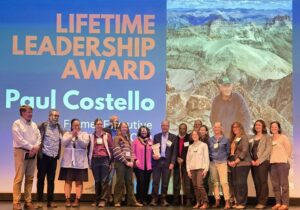 VCRD’s Vermont Lifetime Leadership Award honors an individual whose decades of work have strengthened Vermont’s people and places; who embodies the values that make the state unique; who has provided more than twenty years of active leadership with enduring impact; and who has mentored and inspired emerging leaders across backgrounds and sectors.
Paul Costello served as Executive Director of VCRD for 21 years before stepping down in 2021. Through his leadership, Paul strengthened rural Vermont in ways that will endure long into the future. He engaged communities statewide as they set priorities to build momentum and local vitality; led numerous policy councils to address pressing challenges; and convened statewide conversations to build unity and common purpose. Paul’s influence extends far beyond the programs he built. He has mentored emerging leaders, inspired countless volunteers, and modeled leadership rooted in humility, service, and belief in the power of local people. Today, he continues his commitment to community as a member of the Foundation for a Resilient Montpelier, a leader in the local development corporation, a member of the Montpelier City Council, and a board member for multiple nonprofits. And when he’s not working in service of community, you’re likely to find him on a mountaintop, skinning his way up a backcountry slope, or paddling a stretch of river somewhere across Vermont.
2026 Community Leadership Award: Bill Moore
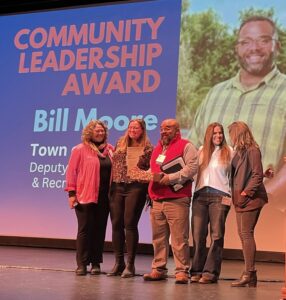 The Vermont Community Leadership Award is presented each year to celebrate Vermonters who exemplify dedication, integrity and honorable service to community and to rural Vermont, and who have had a transformational effect on their communities. We present the award to highlight the work of community heroes who epitomize the best spirit of local community service and whose work has made their community a better place.
Bill Moore has been a driving force behind community and economic development in Brandon, Vermont. In his roles as Deputy Town Manager and Recreation Director, and previously as Economic Development Officer, Interim Town Manager, and Town Moderator, Bill has helped expand free and low‑cost programs and events, including the Brandon Carnival; supported local businesses throughout the Route 7 reconstruction; and championed Brandon’s identity as the birthplace of the electric motor. His leadership has also been central to advancing the town’s flood‑resilience infrastructure. Beyond Brandon, Bill serves as Vice President of the Board of Directors of the Vermont Community Development Association, contributing to statewide efforts to strengthen communities and local economies.
 The 2025 Vermont Community Leadership Award was presented to Vermont’s Long Term Recovery Groups (LTRGs) at the

 The 2023 Vermont Community Leadership Award was presented at the
 Sarah Carpenter, a native of Burlington, was elected Burlington City Councilor in 2020 and serves on the Community Development and Neighborhood Revitalization Committee, the Charter Change Committee and as Chair of the Human Resources Committee. She also is Chair of the Vermont Rental Housing Advisory Board. Sarah served as Executive Director of Vermont Housing Finance Agency 1998-2018 and as Executive Director of Cathedral Square Corp from 1983-1998.
 ts leadership in community-led, permanently affordable housing, receiving the UN World Habitat Award in 2008. Brenda started as a community organizer in rural Vermont, worked as Bernie’s first Housing Director in Burlington, and at the VHFA on Policy and Program Development. She formed and led Northgate Non-profit to acquire, preserve and improve 336 at-risk affordable rentals on behalf of the tenants who govern it now. Brenda was a Ford Foundation leader for a Changing World, and has served on the Advisory Committees of the region’s Home Loan and Federal Reserve Banks and the Boards of the National CLT Network and successor Grounded Solutions Network. Brenda now leads TA\CHT providing direct training and technical assistance on these models across the US and internationally.




 Richford is a small community located along the northern border. It is a former mill town, often cited for its struggles with employment, education and poverty. But Richford has another side, one of committed citizens working together to bring ideas and vision to reality. Albert and Marcia Perry are at the forefront of this side of Richford. Marcia and Albert were founding members of Richford Renaissance Corporation, a nonprofit affordable housing organization; Albert currently serves as the President, Marcia as Secretary. Together Albert and Marcia can be credited with the success of several important projects for Richford, the most visible being the renovation of the Main Street Mill. This former Sweat-Comings furniture plant had been vacant since 1996. With the help of many partners, it is now the home to affordable apartments, the Richford Health Center and Mac’s Market. Albert and Marcia were both tireless in their work to ensure this project became a reality. The Main Street Mill is a beautiful multi-story, 47,000 square foot example of their ability to identify a local need and work to turn a vision into reality. Despite all of their time working on difficult and often frustrating projects, Albert and Marcia remain idealistic and convey a hope for possibilities of the future, and that hope is contagious. Their intentions are honorable. Their work is tireless. Their successes are many.They dream. They listen. They work hard. They are undeniably successful in their individual efforts and either one of them alone is deserving of our award. Any community would be pleased to have one of them working on their behalf. Richford, Franklin County and Vermont are grateful to have them both, and we are all better for it.
 Monty Fischer, Annie Gaillard, Tom Gilbert, Pete Johnson, Andy Kehler, Andrew Meyer, Warren Rankin, Linda Ramsdell, Tom Stearns, and Neil Urie make up this special team who have together accomplished something that no one could do alone. They have built a vision for the Hardwick area as a dynamic center for the future of agriculture in Vermont. They are making this vision come true through hard work, partnership, collaboration and enthusiam. They have included a strong respect for the work of rural people, and the tradition of self-reliance and interdependence.
 With their leadership and inspiration, Bellows Falls has reinvigorated its village center, improved downtown amenities, and built recognition throughout Vermont and beyond as an dynamic center of innovation. Bellows Falls has become a very special Vermont model of the creative economy — it has used arts and cultural events as partial foundations of its revitalization efforts, and done it in a uniquely Vermont way — not trying to be something it’s not to appeal to tourists, but really celebrating what is it and bringing people together. The successful downtown and surrounding core of innovative businesses is testimony to the success of the whole community, but Robert and Richard deserve special credit as motivators, guides, and organizers. Robert McBride is the Founder and Executive Director of the Rockingham Area Museum Partnership (RAMP). Richard Ewald, planning and development director for the Connecticut River Watershed Council, was employed for nine years by the Town of Rockingham first as Historic Preservation Coordinator and then as Community Development Director. In addition to his work for the town, Richard served as the Executive Director of two non-profits – the Bellows Falls Downtown Development Alliance, and the Bellows Falls Area Development Corporation. Together, Robert and Richard have brought people together. They have also told their story to other towns throughout Vermont and helped them look at starting points for their own redevelopment.
